
A Hilariously Honest Post-Mortem on Gay Love, Loss and Lessons Not Quite Learned
by chris carpenter
FilmOut San Diego will host the world premiere of the gay-themed drama Exit Interviews during the 25th annual LGBTQ Film Festival on Friday, August 22 at 7 p.m. at Museum of Photographic Arts in Balboa Park.
Writer-director Garrett Abdo and his cast — headlined by out actor and soap opera royalty Tuc Watkins (One Life to Live, General Hospital, 1999’s The Mummy, Desperate Housewives and the 2020 film version of The Boys in the Band) — will attend the screening.
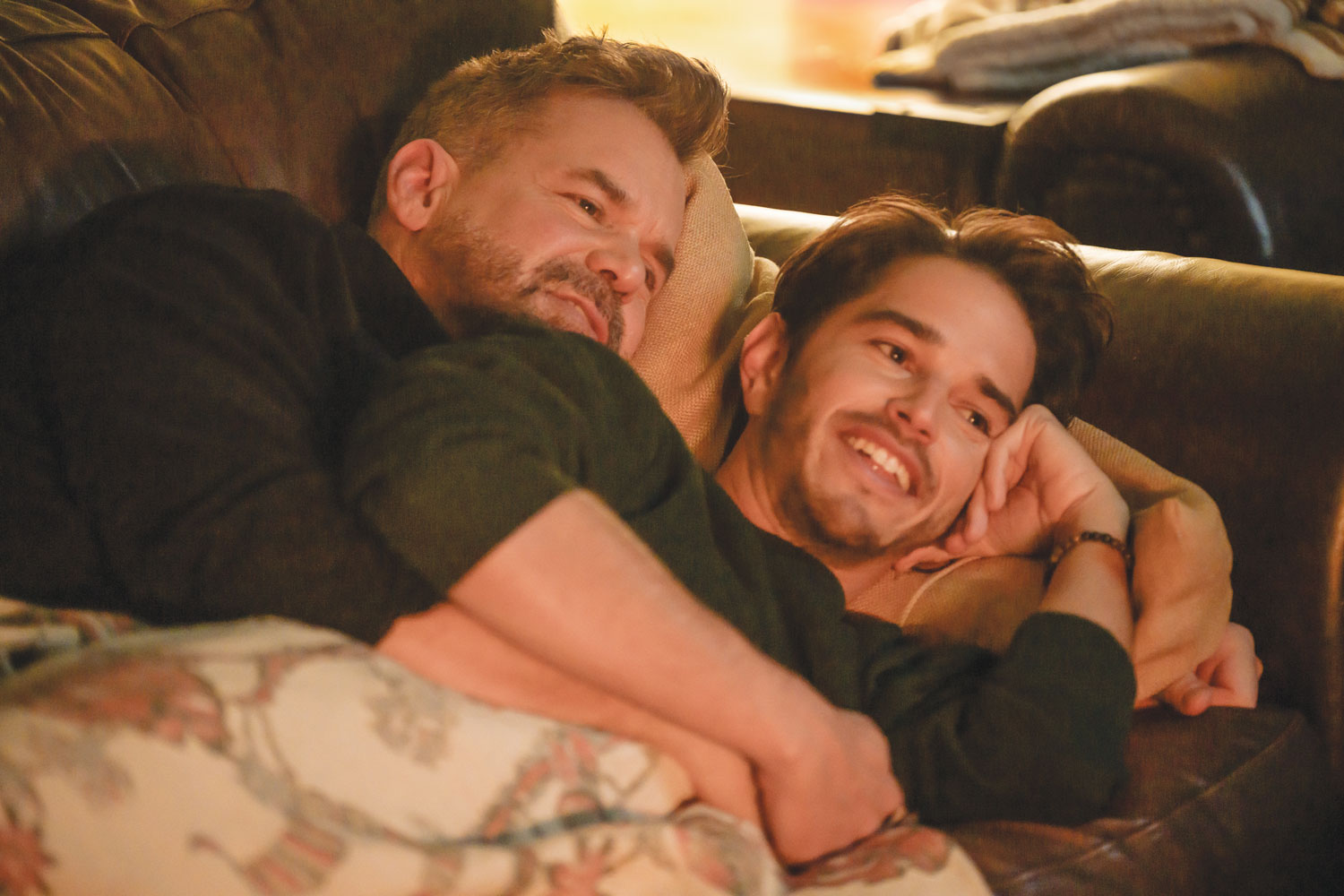
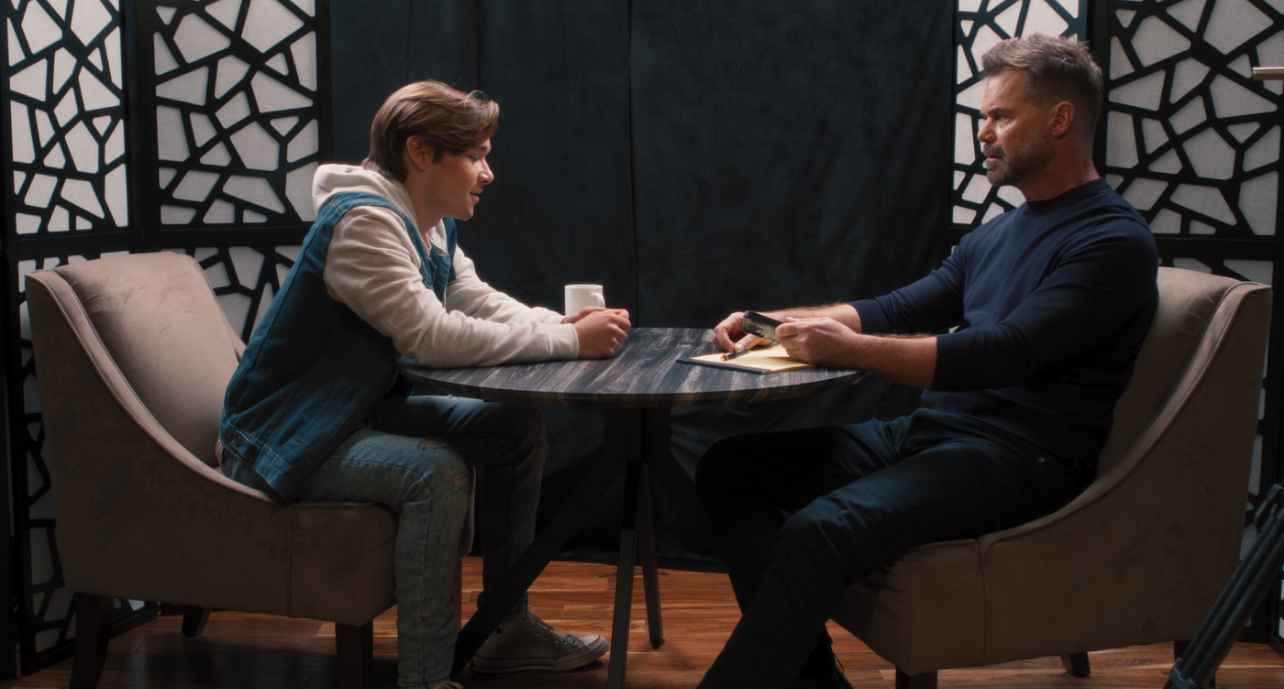
The movie focuses on Robert (played by Watkins), a middle-aged gay man who undertakes a personal documentary project following his long history of failed relationships.
As a professional yet emotionally vulnerable individual, Robert decides to interview six of his ex-boyfriends, each of whom represents a distinct chapter in his love life. His ultimate goal is to discover why these relationships ended and to utilize the documentary as a means of personal growth — or so Robert believes.
Garrett Abdo and Tuc Watkins spoke via Zoom with The RAGE Monthly about their film. The interview has been edited for length and/or clarity.
Hi Garrett! Are you in California?
I live in Atlanta, and we shot the film at my lake house, which is about an hour north of Atlanta but still metro Atlanta. I also own a comedy club and shot parts of the film there. It was the café, the bar, the doctor’s office, the restaurant and an office. It was five locations.
Wow, that’s impressive. Just watching it, you would never think they were all shot in the same building.
We shot the entire movie in nine days. The crazy part was that we actually did it in eight days, and the ninth day we used for pickup shots with Tuc in the kitchen. At one point, Tuc quipped, “OK, Mr., I don’t need nine days.” (laugh)
Since you mentioned your comedy club, I understand you got your start in stand-up.
I have a bachelor of fine arts in acting and directing, and I’m a trained Shakespearean actor. But on a dare, I entered a comedy competition and I loved the feel of it. I started hosting and booking my own rooms, which led to opening the club. I love what I do. I was the first person to headline Dave Chappelle.
At this point, Tuc joined the Zoom call. This writer had interviewed Tuc when his 2016 film Retake screened at the Long Beach QFilm Festival.
Hi Tuc, thanks for your time. Good to see you again!
Good to see you too. Hi Garrett!
Garrett, talk to me about the genesis of Exit Interviews. It’s a very strong film and it feels very personal. Is it kind of autobiographical?
The way I like to explain it is the emotions are real, that I felt with various people, but the people (in the film) aren’t necessarily actual people. But you know, you’re with a particular person, and it sparks an idea in the way of writing and you go from there. I wrote it in October of last year and we filmed it in January of this year, which is a crazy short amount of time.
Writing the script was very emotional. Obviously, Robert is a fictional version of me and to write dialogue for someone sitting across from a fictionalized version of yourself, talking about their faults and what you’ve done wrong, you’ve gotta go deep inside yourself. I ended up back in therapy by the time I finished writing it. (laugh) I thought: “Holy crap, what did I just do?”
But writing it and being able to film it and watch it has been what I call the most expensive therapy session ever. (all laugh) It was so cathartic. I’m actually starting a new relationship right now and literally taking the lessons I learned from writing and directing this, and making sure that I don’t make the same mistakes that the character made in the movie.

Hmm, live and learn. Tuc, what attracted you to this project or the role of Robert?
My favorite thing to do in TV and film is independent film, because it kind of feels like flying the Millennium Falcon. It always feels like it might completely fall apart, and you have to figure out how to keep it flying. And the way to do that is to surround yourself with people that you trust, which is hard to do.
Garrett and I had never met; I don’t think Garrett had ever met most of the people who were on his crew and in his cast. You kind of go with your gut and you hope your gut is right.
When you can creatively get yourself out of a wasp’s nest on set when you’re shooting something, there’s nothing more satisfying to me creatively than doing that. I know that we did that a number of times. We would get deeper into filming and I remember going to Garrett and saying: “I don’t think this scene works, based on what we already did. Can we go reshoot that thing?”
Garrett said: “Of course we can’t go reshoot that thing. We don’t have the time or the money or the schedule to do that.” I said: “OK, can we maybe do an insert and sew it into that?” So, a number of times we found ways to kind of go back and rewrite history a little bit, or to change what we were about to shoot based on what we just did, and I just find that so creatively satisfying.
I admire Garrett for being open to doing that, and for being open to someone else’s ideas, whom you don’t even know. I think the film is a huge success before we even see it because we did it!
I thought it would be difficult pulling off playing a guy with obvious blind spots that I think the audience would be able to see and I would be able to see as the actor, and somehow make it believe that he himself couldn’t see them.
That seemed very difficult, to not get ahead of it as an actor and keep the audience on the hook. We navigated that and we’ll have to see how it works with the audience. I thought that would be a challenge.
Garrett to Tuc: I know what you’re talking about, at least one of those specifics, but no one (in one early screening) even brought it up or mentioned it, nothing. Everybody did such a good job projecting these characters that you could see the give-and-take between them. Anything else that might be superficial that somebody could pick up, they’re not picking up, because they are so entrenched in the performances themselves.
Garrett, how did you go about casting Tuc and the other actors? They were all really great.
I almost made what would have been the biggest mistake of my career. (laugh) One of the producers said: “You need to talk with this casting director.” And I said: “OK, but this is our budget.” And I was this close to saying: “We’ll just figure it out,” but ultimately, I went with my gut and ran with it.
I felt the energy was there. Jeremy O’Keefe is the casting director. What a miracle worker! We cast this in December. Do you know what happens in Hollywood in December? Nothing! He was able to get Tuc and the others, some of whom he is friends with, so they were a little easier to grab, but still. He did an absolutely amazing job.
Was Tuc “the one” for his role as soon as you saw him or heard him?
Well, I mean, it’s Tuc! You know?
It’s Tuc or Brad Pitt. There are no other options.
Garrett: (laughing) Oh my God, I can’t believe you said that.
Tuc: I would fire myself if Brad were interested. (all laugh)
Garrett: I’ve gotta tell you what is, to me, the funniest story that came out of production. It was at my lake house that we used as the set. The first day, we were out there filming and we were using the house across the street for makeup and costumes and all that. The head of the homeowners’ association came up to me and goes: “You’re doing a good job, nobody’s really complaining about anything. So, this story is about you?”
I said: “Well, it’s not really me, but it’s based on my emotions that I felt.” And right then, Tuc came out of the house with the hair and makeup. The HOA guy looked at Tuc and he looked back at me and said: “What’s wrong, Brad Pitt wasn’t available?” (all laugh)
Tuc: What actors will corroborate is that nobody does low-budget independent films for the money; you do it because you love the project. You don’t get in bed with this thinking: “Oh, maybe it will be this or maybe it will be that.”
You do it because you can’t help but do it. It’s like the skits you put on in your parents’ garage when you’re a kid; you just love doing it. Money isn’t really an issue when you’re considering a project like Exit Interviews, to its credit.
Garrett: And to your credit, Tuc, I had such a good time. It was such a comfortable, collaborative set. Literally, one of the greatest experiences of my life was working with Tuc and these guys, and I hope to work more with them. And I’m soooo excited about San Diego! The entire cast is coming; everybody’s coming. San Diego made us the Festival Spotlight film, which is a hell of an honor.

That’s great! Are you planning to distribute it eventually? Or hoping that it gets picked up for distribution or streaming?
Oh yeah. I really want to push for distribution, even if I have to pay for it out of my wallet. The film deserves to be in theaters. It’s a mirror, it really is. I screened it for a small audience up in Ohio and one guy waited til the very end, so he was the last person in the theater to talk to me, and he said: “You just put my entire dating career on film.”
I was blown away by that. It was a great mix of audience members: old, young, black, white, gay, straight. There was a 70-year-old straight couple there and the woman said that she just cried (watching it). It hit home on a lot of the universal themes in it.
Yeah, I was struck by the universality of it. This isn’t just a gay story or a story about gay men. Anyone can identify with one or more elements of it. Tuc, did you learn anything playing Robert? Was there anything about that character or this experience that you took away as new or unique?
Yeah. I think in approaching the character, I went into it thinking I was the hero. I’m the good guy in this story. A hero inspects his life and his relationships, what a heroic or good guy thing to do. And then, as we were shooting it, it kind of dawned on me that this “hero” that I thought this guy was kept getting reminded by a number of people that there are patterns to your behavior that are not heroic. (laughs)
I didn’t see it when I was initially working on the script or while we were initially shooting it. You’re never supposed to judge your characters, as they say, but I think I was judging my character as if he were this great guy. I had blind spots about what his flaws were. If more than one person says, “You walk funny,” then you might want to consider that you walk funny. (all laugh)
filmoutsandiego.com | instagram.com/exitinterviewsmovie
Chris Carpenter has been writing about entertainment since 1996 and a member of Team Rage since 2012. He is a founding member and vice president emeritus of GALECA: The Society of LGBTQ Entertainment Critics.